
AI vs Human Therapists for Mental Health Support: What Canadians Need to Know
Artificial intelligence is changing many aspects of daily life, and mental health support is no exception. Millions of Canadians are already turning to AI chatbots and apps for advice, emotional support, and something that increasingly looks and sounds like therapy.
How Many Canadians Are Using AI for Mental Health Support?
According to a February 2026 national survey by the Mental Health Commission of Canada and Mental Health Research Canada, approximately 6 million Canadians used AI tools for mental health support in the past year. That’s roughly 1 in 7 adults.
As the table below shows, use is highest among younger Canadians and drops off sharply with age. Young men aged 25-34 and women aged 16-24 are the heaviest users, at 29% and 26%, respectively, while Canadians over 55 use these tools at very low rates.
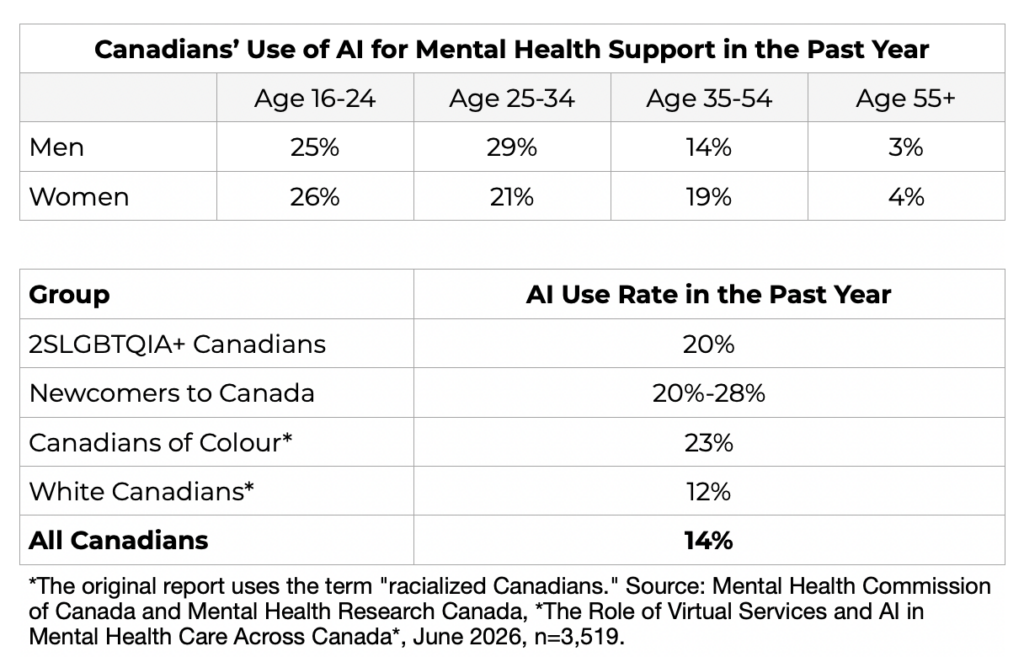
Despite these numbers, only 14% said they trusted AI to provide safe mental health support — meaning many people are using tools they’re not entirely sure they trust.
Searching for the best AI therapist or the best AI for therapy and mental health returns pages of confident recommendations. The apps are polished, the interfaces warm, and the technology is impressive. But before you hand your mental health over to an algorithm, it’s worth understanding what these tools can and can’t do.
What AI Therapy Tools Can and Can’t Do
It’s easy to understand the appeal of AI for mental health support. AIs are available 24/7, they’re free or low-cost, they don’t require appointments or referrals, and there’s never any waitlist. They also respond immediately, in tones that feel warm, patient, and non-judgmental.
For some purposes, that has real value. Research suggests AI tools can be helpful for tracking mood, managing everyday stress, practicing coping strategies, and bridging the gap between sessions with a human therapist. Used that way, as a supplement to professional care rather than a replacement for it, AI has a legitimate role to play.
The problems arise when people begin to treat AI as though it was an actual therapist. Researchers call this a “therapeutic misconception”: the tendency to overestimate what AI chatbots can do and to mistake a digital self-help tool for genuine therapeutic treatment.
We know AI chatbots cannot create genuine therapeutic alliances with people. They can sound empathic, but they cannot actually be empathic. They cannot pick up non-verbal cues, read body language, or sense the things you’re not saying. They have no lived experience of what it feels like to be human and navigate loss, anxiety, relationship breakdown, or grief. And unlike licensed therapists, they are not bound by professional codes of ethics or regulated by bodies that exist to protect you.
There is also a subtler risk. Apps that promise to help you manage your mental health independently can, over time, actually increase dependency and reinforce the social isolation that contributes so strongly to the anxiety, depression and avoidance that drive people towards therapy and mental health support in the first place!
Risks About AI Therapists For Young People
The data showing that younger Canadians use AI for mental health support at much higher rates than older adults is worth pausing on, because age matters here in ways that go beyond simple demographics.
The human brain isn’t fully developed until around age 25. The prefrontal cortex, the part of the brain responsible for judgment, emotional regulation, impulse control, and understanding the long-term consequences of decisions, is still actively growing throughout adolescence and young adulthood. This means that younger people are least equipped to critically evaluate what they’re receiving from AI therapy app, recognize its limitations, or advocate for themselves when the advice they get isn’t right for them. This doesn’t mean young people shouldn’t use these tools at all. It means they need adults in their lives who understand both the appeal and the limitations of AI mental health support, and who can help them make informed choices about when it’s appropriate and when it isn’t.
The Investment Frenzy Behind AI Mental Health Tools
The AI mental health industry is drawing enormous amounts of venture capital money. Ash, one of the most prominent new AI therapy apps developed by Slingshot AI, has raised $93 million USD and has been used by more than 150,000 people since its launch in 2025. That level of investment brings sophisticated marketing and polished interfaces. What it doesn’t automatically bring is clinical proof.
Slingshot AI published a safety study for Ash in late 2025, but independent experts described it as a small, uncontrolled study offering little clinical evidence of the app’s safety or effectiveness. Meanwhile, Ash was withdrawn from the United Kingdom in January 2026 after regulators determined it may go against medical device regulations.
The money flowing into AI mental health tools is moving considerably faster than the evidence supporting their safety and suitability. Again, that’s not a reason to dismiss these tools entirely, but it is a reason to approach them with informed caution.
Why Human Therapists Are Still the Gold Standard
Here are four things skilled human therapists can do that AI can’t:
Human therapists can read and understand your emotions. Your brain is wired for human faces. Decades of neuroscience research confirm that human beings are uniquely attuned to them. We read emotion, intention, safety, and connection through the subtle movements of eyes, mouths, and brows automatically, below the level of conscious thought. When you sit across from a therapist, your nervous system is engaged in a rich two-way exchange that simply has no equivalent in a text or voice interaction with a chatbot.
Good therapists remember your stories and see your patterns. A therapist who has known you for months or years will notice patterns across time, connections between past and present, and subtle shifts in how you’re presenting that even you might not have noticed. That kind of contextual understanding is something no AI can replicate.
Professional therapists are accountable to you. Licensed psychologists and registered psychotherapists in Ontario are regulated by professional bodies that set rigorous standards for training and ethics. If something goes wrong in your care, those bodies are there to protect you. No such accountability exists for AI systems, whose terms of service typically limit liability and whose data practices may not align with what you’d expect from a confidential therapeutic relationship.
Good therapists will challenge you. AI chatbots have a well-documented tendency to agree with you and validate your thinking, even when doing so isn’t in your best interest. Skilled, human therapists respectfully push back, offer different perspectives, and help you examine assumptions you didn’t know you were making. Learning to welcome that kind of challenge is a necessary life skill that builds confidence, resilience and the capacity to navigate conflict. Good-quality relationships require all of those!
The Bottom Line
AI mental health tools are here, they’re growing fast, and some of them may have a useful role to play as a pathway to professional care or as a support between therapy sessions. The data showing that 40% of AI tool users became more likely to seek professional mental health support afterward is genuinely encouraging. But “helpful in some circumstances” is a long way from “a safe substitute for therapy,” and the populations most drawn to these tools are often the least equipped to recognize their limitations.
If you’re considering using an AI for mental health support, use it for what it’s good at: managing everyday stress, tracking your mood, or bridging the gap between sessions with a human therapist. But if anxiety or depression is affecting your daily functioning, your relationships, or your work, please don’t settle for a chatbot. You deserve a real person who will remember your story, notice your patterns, sit with you in the hard moments, and challenge you to grow.
At Shift Cognitive Therapy, we’ve been providing evidence-based psychological care to people in Oakville for over 20 years. If you’d like to talk about whether therapy might be right for you, call us at 905-849-1288 for a brief, no-obligation consultation. First appointments are usually available within one to two weeks, and most extended health benefits cover treatment.